
"Ikigai 2.0" in the AI Era: Reconstructing Purpose for the Post-Instrumental Age

Why Do We Live?
It is a question as old as philosophy itself. But in 2026, it carries
an urgency that no previous generation has faced.
Sam Altman says intelligence is about to become replaceable. Yuval Noah
Harari warns of a "useless class" — billions of people who are not
exploited, but simply unnecessary. Nick Bostrom imagines a "solved world"
where AI handles every practical task, and humans are left searching
for artificial purpose.
If our value has always been measured by what we can do — our skills,
our productivity, our usefulness — then what happens when machines
can do it all?
This article proposes an answer. Drawing on the work of Altman, Harari,
Bostrom, and neuroscientist Kenichiro Mogi, it traces the collapse of
the traditional Western "Ikigai" model — the famous Venn diagram of
passion, mission, vocation, and profession — and introduces Ikigai 2.0:
a new framework built not on "Doing" but on "Being."
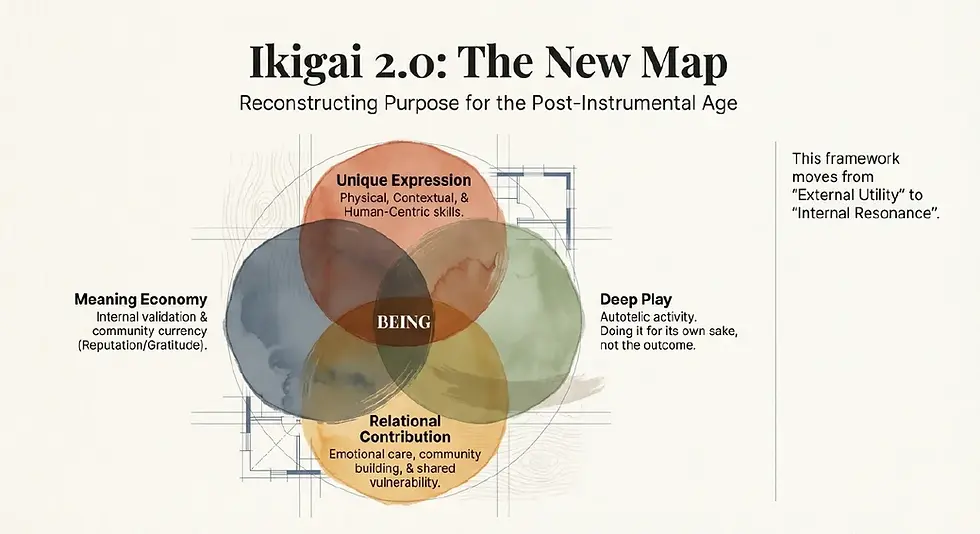
At its center are four pillars: Unique Expression (physical, contextual,
human-centric skills), Deep Play (autotelic activity pursued for its own
sake), Relational Contribution (emotional care and community building),
and Meaning Economy (internal validation and gratitude).
The question is no longer "What can you do?"
The question is "How do you exist?"
→ Read the full article on Medium
---
Originally published on Medium by Kouji Miki.
Follow "Zen and Innovation" for weekly insights on leadership, AI,
and Japanese wisdom.



Comments