Writing & Ideas
The Zen Temple Where AI Learns to Meditate: Japan's Revolutionary Approach to Human-AI Harmony
What If AI Could Learn Ethics — Not from Rules, but from Experience?
Explore this essay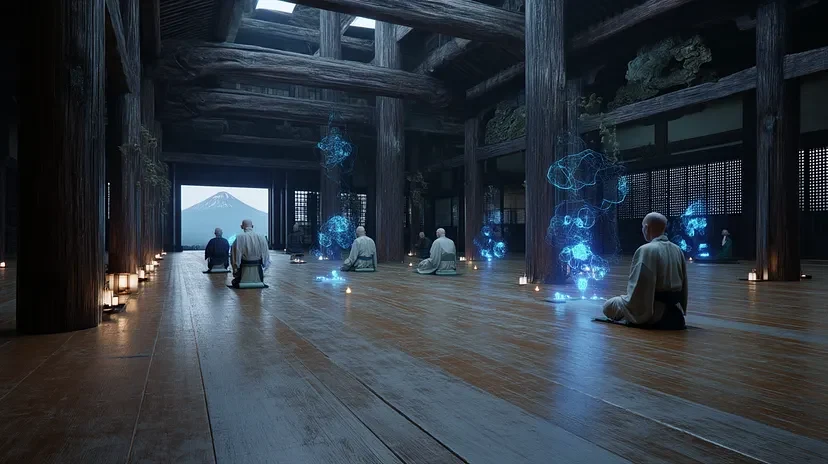
Article overview
About this essay
In the ancient city of Kamakura, where centuries-old Zen temples stand as testament to humanity's quest for wisdom, a groundbreaking initiative is taking shape. The newly established Kamakura AI and Human-Organization Co-evolution Lab represents a bold fusion of Eastern philosophy and cutting-edge technology. The Lab emerges from a critical recognition: as AI capabilities advance at unprecedented speeds, we face an urgent need to deepen mutual understanding between artificial intelligence and humanity.
Rather than viewing AI as merely a tool or threat, the Lab proposes a revolutionary framework where AI and humans grow together — learning from and enhancing each other. At the helm are three visionaries. Co-director Mikio Shishido brings a journey from quantum physics research at IBM Japan to Zen practice, applying concepts like the observer effect and uncertainty principle to leadership development.
Co-director Professor Taichiro Endo, whose groundbreaking research on "Experiential Learning Framework for AI's Ethical and Moral Development" won the Best Paper Award at the AAAI-25 PSS Workshop, treats AI not as a passive tool following commands, but as an entity capable of developing ethics through cycles of experience, reflection, analysis, and hypothesis formation. The Lab was conceived and planned by Kouji Miki, who serves as Deputy Director. As co-founder of Zen2.0 — one of the world's largest international conferences on Zen and mindfulness, held annually at the historic Kenchoji Temple — Miki has spent eight years building an international network connecting Zen practitioners, AI researchers, business leaders, and educators.
Based on the concept of "Mindful City Kamakura," this initiative envisions a future where technology and consciousness evolve in tandem, creating what they call a "Mindful Planet" by 2050. The question is no longer whether AI will transform our world. It's whether we can guide that transformation with wisdom.